


Send Us A Message
How to verify agricultural fertilizers meet nutrient label claims
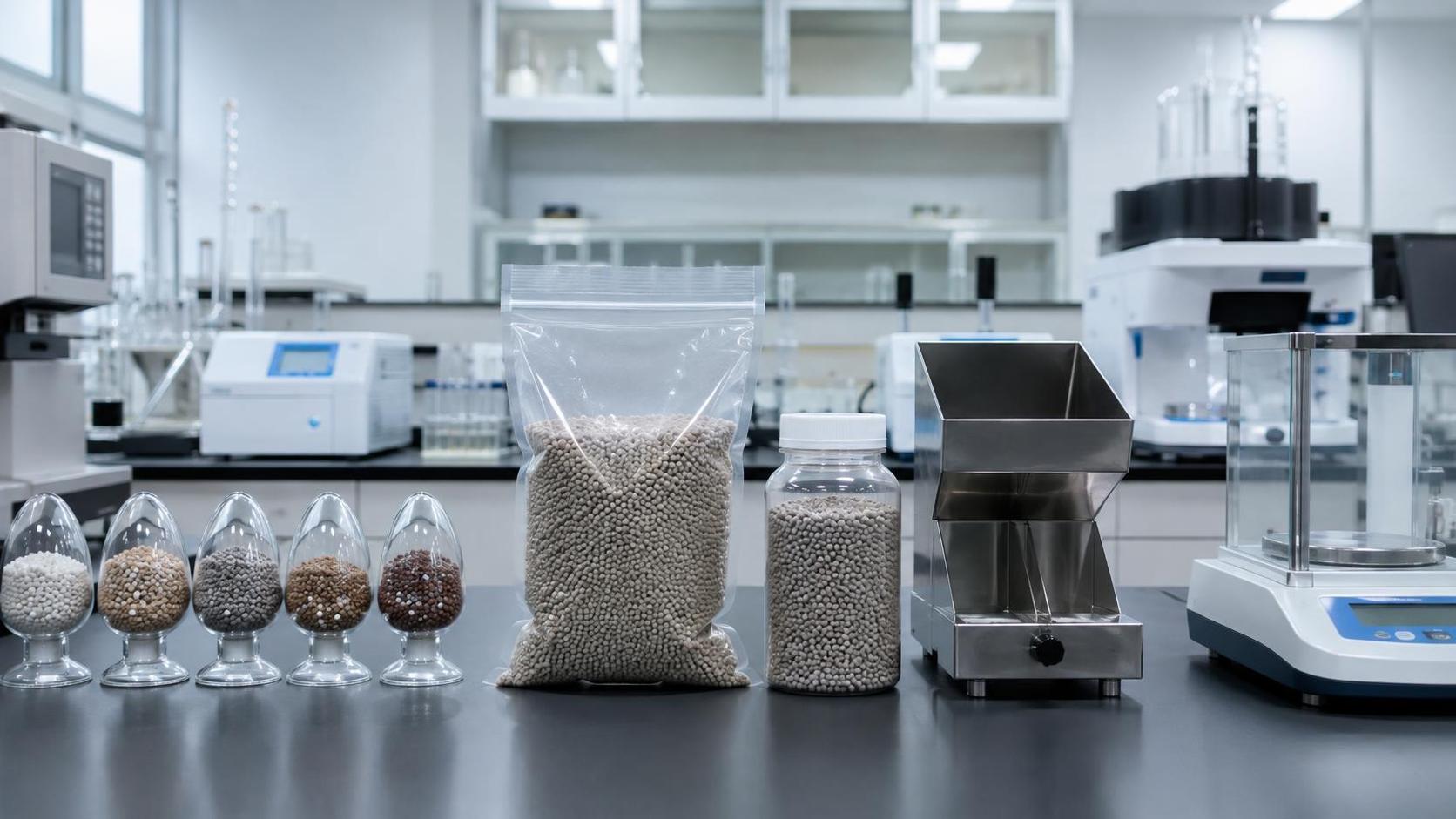
A fertilizer label claim is verifiable only when the declared nutrients, their chemical forms, the sampling basis, and the analytical method all refer to the same product condition. A bag marked 20-10-10, for example, normally expresses total nitrogen, available phosphate as P2O5, and soluble potash as K2O on the stated product basis. A laboratory result cannot be judged against that label until moisture, coating, particle segregation, and reporting units have been reconciled.
Begin with the exact label and the batch documentation. Record the product name, formulation type, batch or lot number, net mass, production date, declared nutrient guarantees, nutrient forms where stated, recommended storage conditions, and any secondary nutrient or micronutrient claims. Retain photographs or scanned copies of the original label, because relabeled bags, translated descriptions, and sales invoices may omit details that affect interpretation.
Read the nutrient statement as a technical specification
The three numbers on a conventional N-P-K grade do not always describe the same chemical forms. Nitrogen may be present as urea nitrogen, ammoniacal nitrogen, nitrate nitrogen, or a combination. Each form has a different analytical route and may be subject to different label requirements in the destination market. Phosphate may be described as water-soluble, citrate-soluble, or available phosphate. Potassium claims are often reported as K2O equivalent rather than elemental potassium. Comparing elemental K from an instrument result directly with a K2O label claim creates an apparent deficiency where none exists.
Clarify the reporting basis before evaluating conformance:
- As-received basis includes the moisture present in the sampled material. This is usually the most relevant basis for a packaged product placed on the market.
- Dry basis removes water from the calculation. It is useful for process control, but must be converted before comparison with an as-sold label unless the label explicitly uses dry matter.
- Elemental versus oxide expression requires a conversion. Phosphorus and potassium results are frequently reported in elemental form by laboratories while fertilizer labels use P2O5 and K2O equivalents.
- Total versus available nutrient is not interchangeable. Total phosphorus may exceed the portion defined as plant-available under the applicable extraction method.
Trace nutrients require the same discipline. A statement such as “zinc” does not establish whether the claim applies to total zinc, water-soluble zinc, chelated zinc, or a specific complexing form. For products containing chelates, the declared chelating agent, pH stability range, and fraction of metal in chelated form may matter as much as the total metal concentration.
Sampling determines whether the result represents the lot
Laboratory precision cannot correct a poor sample. Granular blends can separate during filling, transport, vibration, and handling because particles differ in size, density, shape, and surface treatment. Fine powder may settle in one part of a container, while coated controlled-release granules can remain concentrated in another. Liquid fertilizers may stratify if solids settle or if incompatible components have formed a bottom layer.
Take incremental samples from multiple locations in the lot rather than relying on a single bag or a single point in a bulk container. For bagged material, select units across the lot and draw material from different depths where practical. For bulk product, collect increments during loading, unloading, or transfer, when the material stream is moving. A static surface grab from the top of a pile is rarely representative.
Combine increments into a composite sample only when they represent the same identified lot and the same formulation. Reduce the composite by a recognized splitting method, such as a riffle splitter, instead of hand-scooping a smaller portion. Hand reduction tends to favor larger granules or denser particles. Keep a sealed retention sample, clearly linked to the lot, sampling date, location, sampler, package condition, and chain-of-custody record.
For liquids, mix according to the product's documented handling instructions before taking samples. Do not assume vigorous mixing is harmless: some suspension fertilizers require controlled agitation, while air entrainment or prolonged high-shear mixing may affect density measurements and sample handling. Record temperature, visible sediment, crystals, phase separation, or pressure in sealed containers. Those observations can explain later disagreement between samples.
Match the laboratory method to the claim
The method must measure the nutrient property printed on the label. A total digestion followed by ICP-OES or another elemental technique can provide a strong result for total phosphorus, potassium, calcium, magnesium, iron, zinc, and similar constituents. It does not automatically establish water solubility, citrate solubility, chelated fraction, or plant-available nutrient content. Those claims depend on defined extraction conditions and should be tested by methods that reflect the relevant label language.
Request a report that identifies the sample, analytical method, result unit, sample preparation, moisture or dry matter treatment, detection limits where relevant, and laboratory quality-control observations. A certificate showing only “pass” or “meets specification” is weak evidence when a claim is disputed. Raw values and units are needed to verify the calculation independently.
Replicate analysis deserves attention when a result lies close to the declared minimum. The difference between duplicate results can arise from material heterogeneity, sample preparation, instrument variation, or a genuine nonconforming lot. Review the entire sequence: field increments, composite preparation, laboratory sub-sampling, digestion or extraction, calibration controls, and calculation sheet. Repeating only the instrument reading from the same prepared solution does not test whether the original lot was sampled correctly.
Use tolerances carefully and do not invent them
A label guarantee is not always judged as an exact numerical target. The permitted shortfall, rounding convention, and basis of enforcement may be defined by the jurisdiction where the fertilizer is sold. Internal specifications can be tighter than legal minimums, particularly when products are blended from several raw materials with variable assay. The applicable rule should be identified before a release decision is made; it should not be selected after a low result appears.
When no verified tolerance applies, treat the label value as the acceptance reference and document the uncertainty separately. Measurement uncertainty does not erase a deficiency, but it affects how confidently a result can be distinguished from the claim. A result marginally below the stated content should trigger review of sampling representativeness, method suitability, unit conversion, and laboratory controls before the lot is classified. A material clearly below the declared nutrient after those checks requires containment and investigation.
Do not average results from separate lots to offset a weak batch. Nutrient label claims apply to the product actually supplied, and a compliant later shipment does not correct a deficient earlier one. Likewise, an average of nitrogen, phosphate, and potash percentages does not show compliance. Each guaranteed nutrient needs its own comparison.
Reconcile results with formulation and physical condition
Mass balance is a useful secondary test. For a dry blend, compare the declared nutrient grade with the documented assays and inclusion rates of the constituent materials. The calculation will not replace laboratory verification, but it can reveal an implausible label or a transcription error. If the formulation predicts substantially less nutrient than the bag claim, investigate before dispatch. If the laboratory result is inconsistent with both the label and the formulation record, inspect for incorrect raw material addition, blend segregation, cross-contamination, or sample mix-up.
Moisture is a frequent source of misunderstanding. Hygroscopic fertilizers can gain water during storage, especially if packaging is punctured, seams are compromised, or pallets have been exposed to humid conditions. Added moisture dilutes nutrient concentration on an as-received basis without necessarily changing the amount of nutrient originally placed in each bag. Conversely, moisture loss can raise apparent concentration. The product still must be assessed against the basis required for the claim, but moisture data help separate manufacturing deviation from post-production deterioration.
Physical observations also matter. Caking may make a sample difficult to homogenize. Broken granules can create fine-rich and coarse-rich fractions with different nutrient composition. White crystals in a liquid may indicate precipitation, while sediment may contain nutrient-rich solids that are missed by an unagitated top sample. Record these conditions and preserve representative material; a result from a filtered liquid sample may not represent the saleable suspension.
Maintain a defensible batch trail
A verification file should connect the finished product result to the physical lot. Include receiving records for raw materials, batch or blend records, packaging run details, retained samples, label artwork or label approval, warehouse release status, transport documents, and laboratory reports. The lot number should be legible on the package and consistent across the records. Where repacking occurs, preserve the link between the original bulk lot and the new package code.
Transport and storage records are particularly relevant when testing occurs after delivery rather than at release. Note whether the load was protected from rain, stored away from direct heat, isolated from incompatible chemicals, and kept in intact packaging. A nutrient claim investigation becomes unreliable when samples from different dates, warehouses, or repacked bags are treated as though they came from one unchanged lot.
When the analysis and label do not agree
Place the identified lot on hold and prevent mixing it with other material. Confirm the product identity first: grade, lot number, package size, and whether the sample came from the labeled product rather than a nearby or previously handled material. Then review reporting units and calculation factors. Errors involving P versus P2O5, K versus K2O, dilution factors, decimal placement, or dry-basis conversion are common enough to warrant direct checking.
If the discrepancy remains, arrange a controlled resample from the retained lot or unopened units, using a documented sampling plan. Send portions to a competent laboratory with instructions that match each nutrient claim. Avoid revealing an expected result where blind testing is feasible. Compare the new findings with the original report, sample condition, and production documentation. The investigation should distinguish a label error, analytical error, nonrepresentative sample, storage-related change, and actual formulation nonconformance rather than treating every low result as the same problem.
A reliable verification program therefore rests on alignment: the label language, the representative sample, the analytical method, the reporting basis, and the traceable batch record must describe the same fertilizer. When those elements agree, nutrient claims can be evaluated with evidence that remains useful through release, storage, delivery, and any later quality review.
Send Us Your Inquiry Today
To view the current overseas warehouse inventory list or obtain a tailored logistics solution, please contact us via the form on our official website or by email.