


Send Us A Message
Choosing herbicides for fields with persistent broadleaf weeds
Persistent broadleaf weeds should be treated as a field-specific selection problem, not as a search for the strongest available active ingredient. A product that suppresses emerged plants may still fail to protect yield if it misses later flushes, if surviving plants set seed, or if the crop is outside the label-supported application window. The preferred herbicide program is the one that matches the dominant weed species, growth stage, crop system, soil conditions, resistance history, and application equipment available on the farm.
Start with a precise description of the problem. “Broadleaf weeds” covers plants with very different emergence patterns, leaf surfaces, root systems, seed persistence, and responses to herbicide groups. A field dominated by small annuals after planting calls for a different approach than a field carrying established perennial patches or repeated late-season flushes. Broadleaf pressure that appears uniform from the road can contain several species with different susceptibility, so field scouting should identify the most abundant weeds as well as the plants most likely to survive treatment and replenish the seedbank.
Separate the weed population before comparing products
Species identification matters because apparent treatment failure is often a spectrum mismatch rather than an application failure. Small-seeded annual broadleaf weeds tend to emerge near the soil surface and may be managed effectively with residual herbicides when the treated soil layer remains intact. Larger-seeded species can emerge from greater depth and may escape a short-lived residual barrier. Deep-rooted perennials and plants that regrow from crowns, rhizomes, or root fragments require systemic activity and sufficient leaf area for uptake and translocation.
Growth stage changes the expected result. Many post-emergence herbicides perform best on actively growing seedlings. Once broadleaf weeds become large, shaded, drought-stressed, or reproductive, leaf interception, cuticle thickness, and carbohydrate movement can reduce control. Increasing dose beyond the approved rate is not a sound response. A better decision may be to use an approved sequential treatment, add a compatible residual partner, adjust timing in the next season, or manage patches separately where the crop label and local requirements permit.
Map the distribution as well. Uniform escapes across a whole field suggest an issue with product fit, timing, spray coverage, weather, or residual placement. Clusters along field edges, watercourses, gateways, manure-spreading areas, or machinery access points often indicate a localized source of seed or vegetative spread. These patterns should not automatically be used to judge the field-wide herbicide program.
Build the selection around the crop calendar
Herbicide choice is constrained by the crop as much as by the weed. Crop tolerance is influenced by crop species, variety where relevant, planting depth, seed quality, soil texture, organic matter, temperature, rainfall after application, and crop stress. A treatment that is acceptable in a vigorous, deeply planted crop on a heavier soil may create injury concerns in shallow-planted seed on light soil, especially when heavy rain moves the active ingredient into the germination zone.
Pre-plant burndown, pre-emergence residual treatment, early post-emergence treatment, and later rescue treatment solve different problems. They should not be compared as interchangeable options.
A residual herbicide should be assessed by the length and reliability of its control period, not by the expectation of season-long control under all weather patterns. Dry soil after application can delay activation. Intense rainfall may move some products below the zone where susceptible seedlings absorb them, while also increasing the chance of crop exposure. Soil organic matter and clay content can alter adsorption and availability. These conditions do not make residual products unsuitable; they define the conditions under which a specific rate, placement, and partner treatment are appropriate.
Post-emergence selection requires equal attention to the crop stage. Crop leaves, waxiness, canopy closure, and growth rate affect interception and tolerance. A dense crop canopy can improve suppression of later weeds but can also shield small weeds from spray droplets. Conversely, an open stand exposes more weeds but leaves the crop vulnerable to prolonged competition. Do not delay treatment merely because a few weeds are still emerging if the dominant cohort has reached the upper end of the effective growth-stage range.
Interpret resistance history without oversimplifying it
Repeated survival after treatments from the same herbicide group is a warning sign, but resistance should not be assumed from one poor application. Resistance is more credible when the same species survives a correctly timed, properly applied treatment at the approved rate while nearby susceptible species are controlled. Before changing chemistry, examine nozzle condition, boom height, travel speed, carrier volume, water quality, adjuvant use, field moisture, and weather during and after application. A blockage, poor agitation, hard water interaction, or heat-stressed weeds can produce patterns that resemble resistance.
When resistance is suspected, changing only the product name is insufficient. The active ingredients must be compared by herbicide group and mode of action. Products with different trade names may still exert the same biochemical selection pressure. A tank mix is useful only when each component is active against the target weed at the actual growth stage and used at a meaningful labeled rate. Adding a weak partner mainly adds cost, handling complexity, and potential crop response without materially slowing resistance selection.
For fields with established resistance concerns, an effective program often places multiple active sites of action across the season: a suitable burndown treatment for emerged weeds, residual activity to reduce new emergence, and a timely post-emergence option for escapes. The sequence must be designed around crop restrictions and the target species. A single broad-spectrum post-emergence treatment can look efficient in a clean year, yet repeated dependence on that approach leaves the program exposed when weather delays spraying or resistant plants become more common.
Survival patterns that deserve investigation
- Healthy plants survive in irregular strips matching nozzle passes or boom sections. This points first toward coverage, overlap, nozzle output, or spray pressure rather than biology.
- Only large plants remain while smaller plants of the same species are controlled. Timing, growth stage, drought stress, and inadequate translocation should be examined before resistance is concluded.
- One species survives consistently across several well-applied fields, while other broadleaf species respond normally. This is a stronger reason to investigate resistance and revise the herbicide group sequence.
- New seedlings appear after an initially clean result. These plants may be later emergence rather than survivors, especially where residual activity was shortened by dry conditions or disrupted by soil movement.
Formulation and adjuvant choices affect field performance
Active ingredient concentration alone does not describe a usable herbicide treatment. Formulation influences handling, tank compatibility, mixing order, spray retention, crop contact, and the role of adjuvants. Water-dispersible granules, suspension concentrates, emulsifiable concentrates, soluble liquids, and oil-dispersion products have different physical behavior in the spray tank. The label remains the controlling document for mixing, agitation, carrier volume, approved adjuvants, and restrictions on combinations.
Adjuvant selection deserves particular care. A surfactant, crop oil concentrate, methylated seed oil, nitrogen source, or drift-reduction agent can alter uptake and coverage, but it can also change crop injury risk or antagonize a tank partner. Adding an adjuvant because it improved a different product is a common mistake. The correct choice depends on the formulation, target weed leaf surface, water quality, weather, and the entire tank mixture. More aggressive adjuvant systems are not automatically better when crops are under heat, cold, nutrient, flood, or drought stress.
Physical compatibility should be verified before a large spray batch is prepared. A small jar test using the intended water source can reveal precipitation, layering, excessive foam, or gel formation. It does not prove biological compatibility or crop safety, but it identifies basic handling failures early. Maintain agitation according to the product instructions, particularly for suspension-based products. Settling during a long pause can create uneven dosing between loads and lead to misleading field results.
Application conditions can overturn a sound product choice
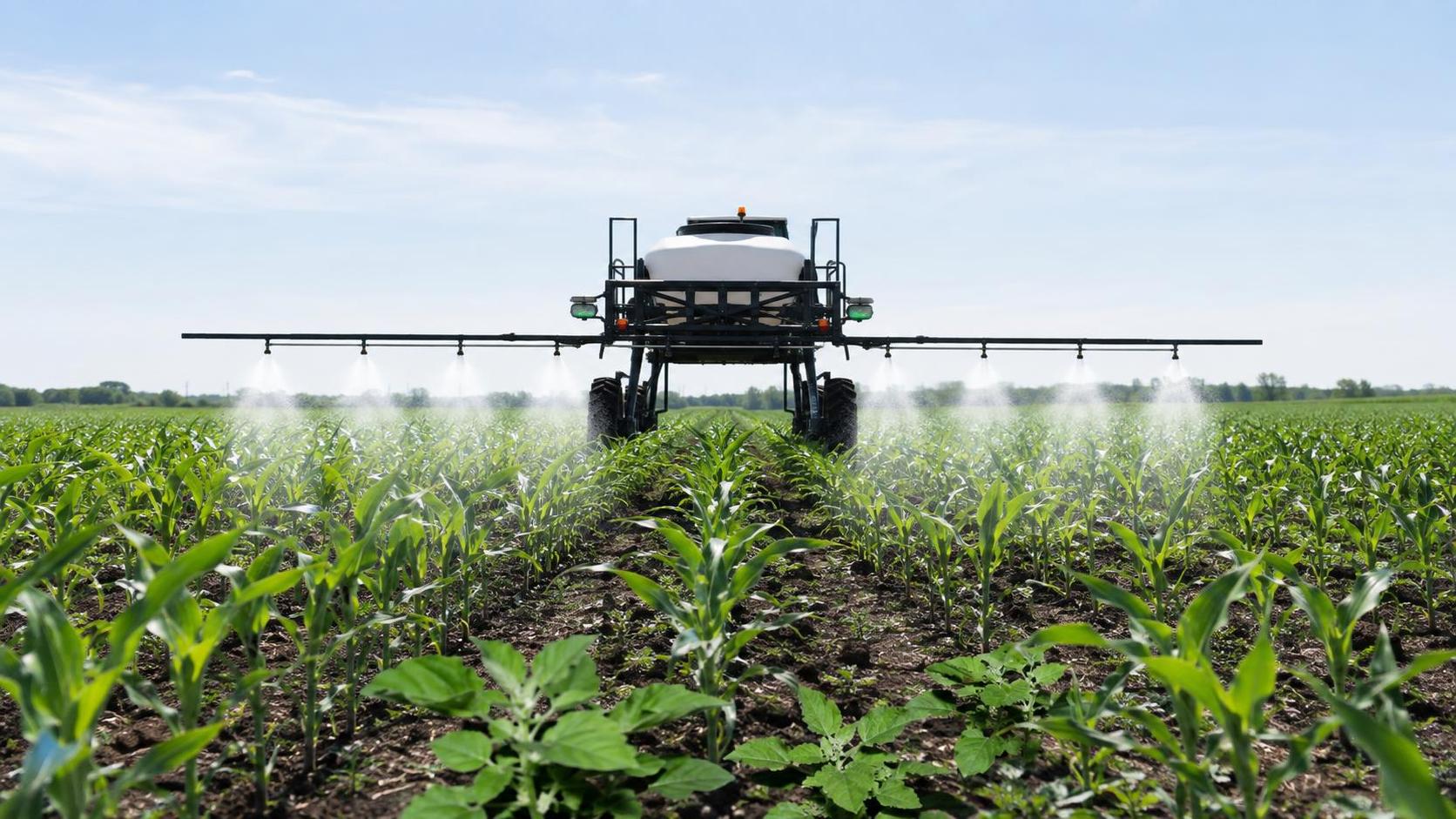
Herbicide performance is tied to delivery. Spray droplets must reach the target leaves or the intended soil zone at a dose that remains within label requirements. Coarse droplets reduce drift potential but may provide inadequate coverage on small, upright, or dense broadleaf foliage. Very fine droplets improve coverage yet are more vulnerable to drift and evaporation. Nozzle selection, operating pressure, boom height, travel speed, and carrier volume should be set as a system rather than adjusted independently.
Weather needs to be evaluated both for efficacy and off-target movement. Temperature inversions can carry fine droplets away from the target area even when wind at boom height appears low. High temperatures and low humidity accelerate evaporation. Wind direction matters when sensitive crops, gardens, water, or non-target vegetation are nearby. Some broadleaf herbicides have particularly important volatility or drift precautions; these restrictions must be reviewed for the exact formulation and local label, rather than assumed from another product in the same general herbicide group.
Soil-applied treatments also depend on field preparation. Large clods, heavy residue, uneven seedbeds, and shallow planting can disrupt uniform herbicide distribution. Mechanical disturbance after a residual application may break the treated layer and allow later weeds to emerge. Where cultivation is part of the system, the timing of soil movement should be considered before selecting a residual herbicide whose performance depends on an undisturbed surface zone.
Compare products using a field-use record
A selection file should connect product information to observable field conditions. Record the weed species and approximate growth stages, previous herbicide groups, crop stage, soil texture, organic matter where known, rainfall before and after treatment, spray setup, adjuvants, water source, and treatment date. Photographing representative untreated and treated areas at consistent intervals makes later interpretation more reliable. Without this record, a product may be rejected or repeated based on memory rather than evidence.
Evaluate control separately from crop response. Leaf cupping, chlorosis, stunting, stand reduction, delayed growth, and uneven maturity do not carry the same significance, and their timing matters. Temporary visible symptoms may not translate into a meaningful crop effect, while subtle stand loss early in the season may have larger consequences. Compare treated areas with an untreated strip where practical and safe, because weather, compaction, nutrient variation, and pest pressure can resemble herbicide injury.
Persistent broadleaf weeds are rarely solved by one spray decision. The most durable choice aligns herbicide activity with the actual weed population, preserves crop tolerance, uses application conditions that support performance, and leaves enough flexibility for later emergence or resistance-related escapes. A program built from documented field observations is easier to refine than one built around a single product result.
Send Us Your Inquiry Today
To view the current overseas warehouse inventory list or obtain a tailored logistics solution, please contact us via the form on our official website or by email.